The depiction of the orange in narrative stories as a metaphor for protagonists and characters from previous epochs became ever more present, in that it was used to describe the distinctive characteristics of a person with an apparently tough outer skin (like the peel), but soft and sweet soul (like the inner fruit).  In the 30’s Vittorini wrote his famous, “Il Venditore Di Arance”, (the orange vendor) which told of the tragic Sicilian and his young wife who are forced to eat unwanted oranges to the point that he no longer holds the physical fruit in his hand but his own despair, a distinctive trait of his own misery and diversity.  Vittorini writes, “I watched the little Sicilian man from his wife, a child, desperately peeling the orange and desperately eating it with anger and frenzy, without any desire, and without chewing, swallowing and cursing, fingers wet with orange juice in the cold.  And he, the little Sicilian, remained silent in hope, then he looked at his feet and at his wife who was sitting motionless, dark, closed off,  on the sack, and he became desperate and desperately bent down and pulled a string from the basket, he took out an orange and he desperately offered it, still bent down, to his wife, and after a silent refusal from her he was desperately depressed with the orange in hand and he began to peel it for himself, to eat it, swallowing as though he were swallowing a curse”.
 

Mount Etna is the highest and most fascinating active volcano in all of Europe.

From her — yes to us Etna is female! — summit we can witness the contrast of the blue ocean below and the gray and red of her smoke and fire that waft up from the crater to touch the sky.

In the longer months the dark almost alien looking terrain is transformed into majestic snow-covered peaks.  Thunderous explosions, clouds of smoke, and fountains of magma are the show you can expect from Etna when she’s in eruption.  All of a sudden the sky turns to fire and black volcanic sand and ash transform the landscape.  From the mouths of the volcano flows bright red rivers of incandescent lava, cutting their paths down to the Valle del Bove where the landscape is something of another world.  
No trees, only black sand and volcanic rock accompanied by the dull rumble from the belly of the volcano. If you are staying in Taormina and want to find out how you can visit Etna read about the best 5 private tours to Mount Etna or take a chance to book an incredible scenic flight over her Majesty Mount Etna.

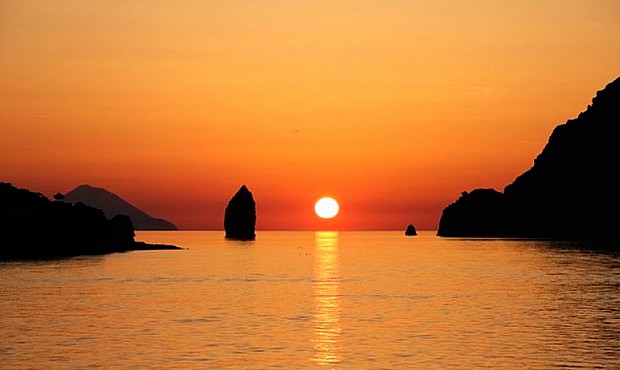
The Aeolian Islands: Seven islands, seven days to sit with a glass of Malvasia in hand and admire the seven sunsets one more beautiful than the last.  After a day of exploring the breathtaking bays there is nothing more relaxing or gratifying then sprawling out in a hammock and watching the sunset, or better yet on board a boat where the view is always unbeatable.  Stromboli is in constant eruption and as it puffs the sky changes from blue to a kaleidoscope of oranges, purples, and pinks.  Sunsets like these are a unique island privilege resulting in a multitude of emotions and sensations that those last rays of light make hard to put into words.  We are sure of one thing though; that we are the witnesses of a strange beauty that admired from any vantage point makes for the perfect trio of earth, water, and fire.

Immagine correlata

Noto is an extraordinary example of one of the cities completely reconstructed in the meridian baroque style after the devastating 1693 earthquake.  Palazzo Trigona is one of the most interesting examples of private construction in the city, as it presents a typical “U” design used by Noto’s residence, where the front of the building is aligned with the main street or Corso.  In order to access the building one must enter through the main entrance located on the main street and then proceed up a monumental staircase to the main floor where there are a series of rooms decorated with grotesque vaults that are unique to Noto’s palatial architecture.

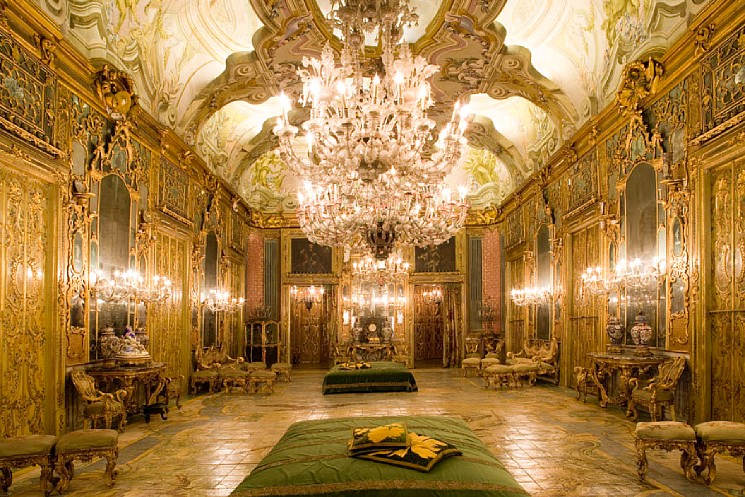
In the heart of the Kalsa neighborhood, an area rich with imposing aristocratic structures, stands one of the most important mansions in Sicily: Palazzo Gangi; the credit of which its present fame must be given to its inestimable artistic value.  During the second half of the 18th century a sort of contest broke out amongst the prominent members of Palermo’s aristocracy.  After the earthquake of 1751 when construction was at an all time high simply in order to cope with the damage, there became a quasi race to rebuild in the most ostentatious and magnificent style possible.  Palazzo Gangi is a remaining example of this phenomenon.  Its Galleria degli Specchi (Hall of Mirrors) is considered a masterpiece of the Sicilian baroque, located beneath a spectacular double perforated ceiling whose ideation is most likely in reference to Gigante.


Taormina experienced a long period of decline during the Spanish domination and up until the 18th century when it was able to renew its prestige by becoming one of the most fascinating destinations for foreigners coming to Sicily.  Thanks to this, an evocative image of Sicily’s historical and natural treasures was diffused throughout the world.  The English have always been drawn to Sicily, so much so that Robert Hawthorn Kitson was so struck by its beauty that 3 years later he designed his future home and established his residence.
He would call the villa and garden Casa Cuseni and was so inspired by the villas of the Italian Renaissance that he built in homage to that style.  In his design the garden is of great importance. Built on split-level terraces that rise steeply towards the villa, they are strewn with giare, terracotta vases, and Rococo-decorated basins and fountains.  The most captivating part of the garden is found on a hill behind the house, paved with mosaic cobblestones displaying the use of local materials and craftsmanship.


It was May 3rd, 1787 when Goethe, passing through Catania, was received at the prince of Biscari’s palace.  One would imagine that the Baroque architectonic design of the illustrious residence must have impacted the writer from Frankfort, who was a great admirer of the classical world?  No indeed, he never wrote a word about the palace.  Instead, he was ecstatic about the incredibly rich collection of antiques that were sprinkled throughout the prince’s apartments.   Among the various symbolic spaces in the palace, The Gallery of the Birds and Don Quixote’s room stand out as incredible examples of Sicily’s chinoiserie.  

In Bagheria (PA), a town pre-chosen by the last century’s aristocracy to build their suburban mansions, the eighteenth century represents the golden age of building and construction.  One of the finest examples of original Bagherese architecture is Villa Valguarnera.  Maria Anna Gravina, the daughter of the prince of Gravina, and wife to Giuseppe Valguarnera, bought a little hill where she would build her villa and give it the distinct advantage of being higher than all the other mansions in the surrounding areas.  Villa Valguarnera was born independent of all agricultural functions and epitomizes the mindset of the time. It was created with the soul purpose of being a country home for the city folk, viewed as a seat of worldliness and splendor in a more private setting, and a demonstration of the Valguarnera family’s power and decorum.

Immagine correlata