Has anyone ever come to Sicily, even just once, and not noticed a Testa di Moro sitting on a balcony, or placed in a traditional Sicilian restaurant, or being sold in one of the many ceramic shops?  Majolica art was brought to Sicily by the Arabs, who taught the Sicilians how to create these truly marvelous masterpieces of art.

There are many different types of objects that can be made by using distinct colors, forms, and motifs painted on the ceramic. 

However, the most fascinating and popular ceramics are the Teste di Moro. The legend behind these figures comes from the XI century when the Moors dominated Sicily and, like so many legends, is supposedly all the fault of Cupid.

One day, a girl who lived in the Arab district of Palermo, the Kalsa, was taking care of some plants and flowers on the balcony of her house.  Suddenly, a dark-skinned merchant passed by and they immediately fell in love with one another.  They began their love story together until the young girl discovered that her lover already had a wife and children waiting for him back in his home country.

One night while he slept, the girl, crazed with jealousy, thought of a way to make him stay with her forever!  Without blinking an eye she cut off his head and decided to use it as a vase to grow her beautiful basil.

As people would walk by her balcony, they began to become jealous of her thriving basil, and so they began creating colorful vases with clay heads.  Today there are many different styles of ceramics heads, but the most traditional are a man of color and a beautiful girl.

In Sicily, the smell of almonds is a major part of flavors and traditions.  The warm sweetness of this fragrance takes us on a sensorial and emotional journey to one of the most enchanting regions in the Mediterranean.  The almond is native to central-western Asia and lower China. It is a typical plant found in Sicily and reaches its full splendor in springtime when white and pink flowers bloom and consume the trees.  Its flowers are used in the production of delicate cosmetic products, while the milk pressed from the fruit is used as an energizer drink thanks to its anti-inflammatory and refreshing properties. Almond oil is also excellent for soothing and healing.  Since it is the first tree to bloom in the spring, the almond is a symbol of renewal and hope.

A base ingredient for many fragrances and colognes, Sicilian Bergamot is a fresh, fizzy, and citrus-y scent.  Closely related to the lemon, Bergamot contains some 350 polyphenols with antioxidant, anti-inflammatory, and vasoprotective properties.  Besides drinking a mix of bergamot and orange juice, you can grate the peel and use a touch of aroma to amp up a risotto, fish dish, or even dessert.  Its perfume is extracted from the essence of the peel, and its scent immediately recalls Sicilian tradition, sicula magic, sun, heat, and citrus.    

The lemons that grows on the Ionic riviera have an overwhelming scent, are beautiful hanging on the tree, taste unlike any other lemon in the world, and have an abundance of healthful properties.  Imagine an embroidery with the colors that echo the impressionist mood.  Immersed in a palette of typically Sicilian hues like the unique yellowish green and the blue of the sea, then add the dark green of the leaves and the undefined ocher of the millenary volcanic land.

Jasmine is one of those unmistakable scents that is capable of immediately evoking memories of one’s homeland.  This is especially true for Sicilians. During the hot long days take a minute and relax in the shade of the jasmine.  Your senses will glaze over with the smell of the flowers, made even stronger by the summer heat.  Jasmine’s nomenclature derives from the Arab, Jsmin, and has been appreciated since ancient times for both its beautiful blooms as well as its essential oil.  Many herbal and perfume shops carry the scent, and thanks to its unmistakable aroma it has been incorporated into desserts, gelati, granite, and sorbet, to help tell the ancient tales of Sicily.


In the 2000 film, Malena, the fantastical city of Castelcutò is constructed using primarily images of Noto and Syracuse.  Like so many imaginary cinematographic locations, Castelcutò represents a type of hyper-Sicily.  In many ways the place is imagined to be a kind of co-protagonist in the storyline.  It creates a perfect Sicily, dense and full, where an abundance of stereotypes help to explain the characters in the film.  Without a doubt the identifying crux that makes Castelcutò recognizable is the Piazza Duomo of Ortygia and Syracuse.  The location is reiterated multiple times in the film and often represents Bellucci’s “catwalk”, animated by comments from the bystanders.  This unchanging location works as a counterbalance to the protagonist’s metamorphosis and parable up until the bitter end.

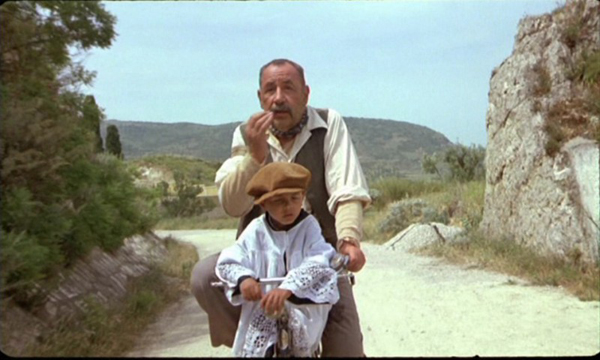
In 1988 Giuseppe Tornatore signed this unforgettable film that would go on to win a 1990’s Oscar and Golden Globe for Best Foreign Film.  When Nuovo Cinema Paradiso came out in theaters it had little success in Italy, except in Messina, where the cinemas would offer a free viewing of the film that viewers, upon exiting the theater, could pay if they felt so inclined. This film is bursting of Sicily.  Starting with the character Alfredo, who was inspired by Alfredo Vaccaro, a Syracusan puppeteer who met Tornatore and told him the story of his profession along with all the limitations of the time.  The village of “Giancaldo”, the setting for the story, was actually constructed to be a mountain town above Bagheria, in the province of Palermo.  The scenes filmed in the so-called “Giancaldo” were actually filmed in Palazzo Adriano, Castelbuono, Cefalù, and other locations in the Palermitan provinces.

Born in Catania, Giovanni Verga was a playwright, writer, and one of the most important interpreters of the veristic literary current.  Verga’s verismo style is characterized by an attention to the everyday life of different social classes, with particular reference to Sicily, his motherland.  Acitrezza, a small fishing village that lies on the coast of the Ciclopi (cyclops), was chosen by Verga as the perfect geographic environment for his story.  Life in Acitrezza is very rural, archaic even, marked by a restricted and closed mentality but faced with the impending collision with the modern world and all its progress and contradictions that will unsettle the compact, conservative, and traditional society.  The story, in fact, is set in the years immediately following the unification of Italy, and the particulars of that historical moment create the microcosm in which the Malavoglia live and will implode.  The extension of the new and unified state brings to the town some elements of modernity that are welcomed with suspicion and fear from the community.  Eventually these changes contribute to the social fabrics destruction and create a divide between those who refuse anything new and non-traditional, and those who are fascinated by novelty.  The home, hearth and domestic refuge, is a very important place to the characters who, having suffered great family loss, are trying to get back to a place of happier memories; the house of the Nespolo (Medlar fruit).  It is easy to understand the bitter and painful feelings that arise when the house is to be sold in order to pay off a debt, as it happens in the case of the Malavoglia family.  The good of the family is of the highest value.


Il Gattopardo by Tomasi di Lampedusa is considered a historical novel in that it narrates the event of Garibaldi landing in Sicily that later lead to the annexation of the island to the Piedmontese kingdom of Savoy.

Through interior events, political intrigue, and purely island concerns and issues, the reading faithfully depicts the various details and motivations of the socio-historic situation on Sicily at the time.

Tomasi wrote “For over twenty-five centuries we’ve been bearing the weight of superb and heterogeneous civilizations, all from outside, none made by ourselves, none that we could call our own…,and yet we have been a colony for two thousand five hundred years”.

This is to testify the fact that Sicily has always been a land of conquest, and even in the case of the Piemontesi, although armed with good intentions, they are merely the umpteenth foreigner to propose themselves governor of the island.

Tomasi also describes how the island itself, geographically speaking, has grown in its own image and likeness the Sicilian people, emphasizing how, “Sicily, the climate, the Sicilian landscape.

These are the forces which have—and perhaps more than foreign rule and defilements – built our spirit: […] this land, in which the hell around Randazzo and the beauty of the bay of Taormina are separated by only a few miles; this climate that inflicts six months of fever upon us […] and still after storming rains, which drive the dry streams crazy, drowning beasts and men right there where two weeks before they both collapsed with thirst.  This violence of the landscape has formed our character […]”.


Between Realmonte and Porto Empedocle (Agrigento) there is the white cliff known as Scala Dei Turchi (Turkish Steps).  The rock is made of calcareous, tender, clayey, marl and is blinding white in color.  Mother nature, the greatest of artists, along with the ocean and brackish breeze has over time worn down the rock face and smoothed every edge to create a soft and sinuous series of terraces or steps.  Taking advantage of the blinding white, the sea here shines an even more brilliant blue, and when seated upon the steps gazing out into this intensity, it’s very easy to drift to your happy place.  The form that this monument of nature has assumed is similar to that of a stairway, hence its name stems from the legend that during the Moorish invasion that raged in ‘500, the “Turks” (erroneously named) landed near today’s Realmonte and climbed up this cliff.